


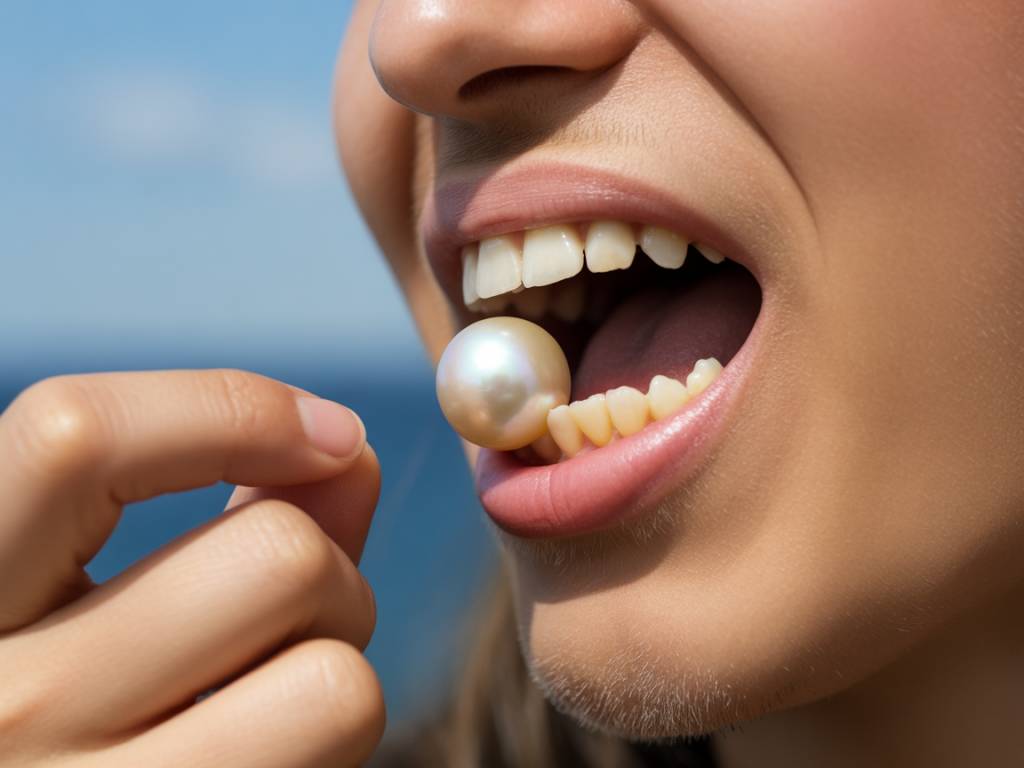
There are sentences I never thought I’d write, and “So… I swallowed a pearl” is very high on that list.
And pourtant, here we are. Maybe it slipped off an earring while you were putting it on in a rush. Maybe it was floating elegantly on top of an oyster, and you got a bit too enthusiastic with your fork. Or maybe your toddler decided pearls look like chic little snacks.
Whatever brought you here, let’s walk through what actually happens when you swallow a pearl – and when it’s time to stop scrolling and call a doctor.
First things first: Is a pearl toxic?
Short answer: no.
Real pearls are made mostly of calcium carbonate (the same family as chalk or some antacids) layered with organic material. On the “toxic things you can accidentally swallow” scale, pearls are very low-risk from a chemical perspective.
That means if you’ve swallowed a single, smooth, small pearl and you’re breathing normally, not in pain, and not choking… you can usually take a breath (a real one, not a dramatic one) and relax. The danger, when there is one, comes from:
So the question isn’t “Is the pearl poisonous?” but rather “Can it get stuck, block something, or injure something on the way down?”
What actually happens inside your body when you swallow a pearl?
Let’s walk through your pearl’s little roller-coaster ride.
Step 1: Mouth to esophagus. If you swallowed it (and didn’t choke), your pearl has probably slipped into your esophagus – the tube that takes food from your mouth to your stomach. If it’s small and smooth, it will usually slide down with no drama.
Step 2: Esophagus to stomach. Once in the stomach, the pearl is basically a tiny guest at an acid party. But unlike food, it won’t dissolve in any meaningful way. Pearls are hard enough that stomach acid isn’t going to melt them overnight.
Step 3: Through the intestines. From the stomach, things get sent into the intestines. Here, your classy little bead usually just… travels. Like any other small, hard object (think: a seed, a tiny bead, or a small pill casing), it’s likely to be carried along and eventually be evacuated naturally.
For a healthy adult, a small, round pearl will typically leave your body within a few days – quietly, unceremoniously, and definitely less glamorously than when it arrived.
When is swallowing a pearl usually not a big deal?
Let me be crystal clear: this is not medical advice, and if you’re worried, you should absolutely talk to a professional. That said, in many cases swallowing a pearl is more of a story than a medical emergency.
The situation is often low-risk when:
In those calmer cases, doctors will often tell you to do… basically nothing, except:
Think of the pearl as a very expensive, very unnecessary fiber supplement that doesn’t get absorbed.
When you should worry – and seek help quickly
Now, let’s talk about the red flags. Because sometimes, swallowing a pearl (especially from jewelry) is a reason to stop reading this and go get checked.
You should seek urgent medical attention if:
These signs can suggest that:
In those cases, doctors may need to locate the object via X-ray or other imaging, and sometimes remove it with an endoscopy (a small camera passed through the mouth) or even surgery, in rare cases.
What if the pearl was part of jewelry?
Now we enter the “this could be risky” chapter. A pearl by itself is one thing. A pearl still attached to an earring post, a ring, or a metal clasp is another story.
Metal components can introduce several problems:
If you swallowed:
you should treat this as more concerning than a lone pearl. You may feel totally fine at first and still need an evaluation, especially if the object is large or irregularly shaped.
In most modern emergency departments, this kind of thing is more common than you’d think (children putting jewelry in their mouths, adults with nose piercings, tongue bars, etc.). So don’t let embarrassment stop you from getting help. Doctors have absolutely seen stranger things. Promise.
What if a child swallowed a pearl?
Ah, the toddler era: when the world is a buffet, and jewelry is apparently finger food.
With kids, the threshold for concern is lower. Even a small pearl can be an issue if:
If your child just swallowed a small, smooth pearl, is breathing normally, and seems unbothered, many pediatricians will recommend monitoring at home. But if you’re unsure what exactly they swallowed (pearl, bead, battery, magnet, metal part?), you should assume it could be serious and contact medical services immediately.
Two important notes for kids:
When in doubt with children, it’s always better to be “too worried” than not worried enough.
Can a pearl show up on an X-ray?
This is where reality is slightly less cinematic than we’d like. Pearls aren’t always clearly visible on standard X-rays the way, say, a metal earring would be. Calcium carbonate sometimes shows up more faintly, and depending on the size and the machine, your pearl may or may not appear clearly.
But if you swallowed pearl jewelry with metal parts, those metal elements are usually very visible. That’s often how doctors figure out where it is and whether it’s moving along or stuck.
Sometimes, if they can’t see it well on an X-ray but your symptoms are worrying, they may use other imaging methods or perform an endoscopy to check more directly.
Should you try to make yourself throw it up?
No. Just… no.
Inducing vomiting without medical instruction is usually a bad idea:
If a doctor wants the pearl out the way it came in, they’ll use controlled, safe methods (like an endoscopy) rather than DIY techniques from a panic-fueled Google search.
What about “natural remedies” – oil, bread, or lots of water?
There’s always that one friend or forum that suggests swallowing a mountain of bread to “push it down” or chugging olive oil like it’s wellness shot day. Let’s be honest: it sounds more like a cooking experiment than a medical solution.
Drinking small sips of water to help something smooth go down is reasonable if you’re comfortable and not choking. But trying to force food on top of an unknown object can be dangerous, especially if it’s stuck or sharp.
If you feel something is lodged in your throat or chest, skip the kitchen remedies and talk to a professional instead of turning your esophagus into a test lab.
How long does it take to pass a pearl?
Everyone’s digestive system runs on its own schedule (some of us are more “express train,” others are “Sunday stroll”). In general:
If your doctor is aware of what happened and isn’t concerned, they may simply tell you to watch for symptoms and carry on with your life (and your outfits). If days go by and you develop pain, fever, or digestive changes, that’s the moment to check back in.
And no, you do not *have* to go hunting for the pearl in your stool unless you really want closure (or the pearl back). From a medical point of view, absence of symptoms can be enough in many cases. From a jewelry-collector point of view… well, that’s between you, your gloves, and your determination.
A little perspective: you’re not the first person this has happened to
People swallow strange things all the time – pins, beads, screws, tiny charms, even entire rings. A loose pearl is practically elegant in comparison. Whether it fell off while you were trying on earrings over the sink (always a risky business) or you got overexcited at a seafood dinner, you’re not uniquely clumsy or doomed.
What you are is human. Humans rush. Humans get distracted. Humans laugh in the middle of a bite. Humans have kids who think “don’t put that in your mouth” is a suggestion, not a rule.
So be kind to yourself while you decide what to do next.
How to avoid a repeat performance (and keep your pearls where they belong)
If this little adventure has made you side-eye your jewelry box, you’re not wrong. A few practical habits can reduce the chances of your accessories turning into appetizers:
Pearls are meant to be worn, admired, and maybe passed down to the next generation – not digested by it.
When in doubt, trust your body – and your doctor, not the internet
If you’ve swallowed a pearl and you:
then chances are, your body has handled the incident quietly, like the discreet queen it is.
But internet articles (yes, including this one) can’t see your body, scan your chest, or feel your abdomen. If something feels wrong, too intense, or just “off,” never hesitate to reach out to a healthcare provider and say the sentence out loud: “I think I swallowed a pearl.”
They’ll take it from there – no judgment, no gasp, just the calm, practical follow-up you deserve. And once everything is sorted, you’ll be left with a great story, a slightly new respect for your jewelry, and maybe a quiet promise to yourself:
Next time, the pearl will stay on your neck, not on your digestive to‑do list.